

الشرح
Introduction to Enlargement and Scale Factors
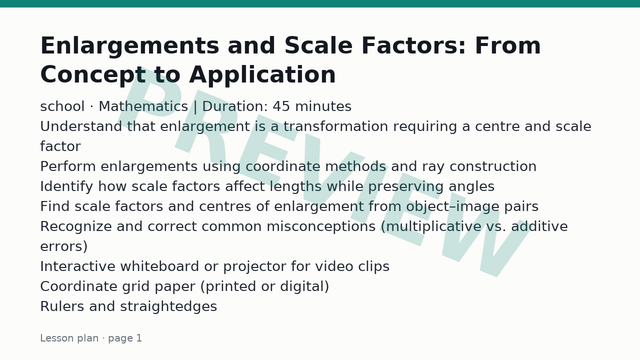
Enlargement is a transformation that changes the size of a shape without changing its mathematical similarity. Unlike translations, rotations, and reflections, which are rigid transformations preserving both length and area, an enlargement alters lengths proportionally. Every enlargement requires two pieces of information: a centre of enlargement and a scale factor. The centre of enlargement, usually labelled as a point C with coordinates (x, y), acts as the fixed anchor point from which all distances are measured. The scale factor, often represented by the letter k, dictates how much larger or smaller the resulting image will be compared to the original object.
When the scale factor is a positive integer greater than 1, the shape grows in size and moves further away from the centre of enlargement. When the scale factor is a fraction between 0 and 1, the shape shrinks, producing an image that is smaller than the original object, and moves closer to the centre of enlargement. If the scale factor is exactly equal to 1, the image is identical in size and position to the object, resulting in a congruent shape that lies directly on top of the original. Negative scale factors and zero scale factors exist outside this specific lower-secondary focus, but for positive scale factors, every vertex of the object is mapped along a straight ray starting from the centre of enlargement and passing through that vertex.
Performing Enlargements Using Coordinates and Rays
To perform an enlargement on a coordinate grid, specific procedural steps ensure accuracy. Given an object with vertices defined by coordinates, and a centre of enlargement C with coordinates (a, b), the new coordinates of the image vertices are found using vector distances. For any vertex V with coordinates (x, y), the horizontal distance from the centre of enlargement is x minus a, and the vertical distance is y minus b. To find the corresponding image vertex V prime, multiply both the horizontal distance and the vertical distance by the scale factor k. Then, add these scaled distances back to the centre coordinates a and b. This gives the image coordinates as a plus k times open bracket x minus a close bracket, and b plus k times open bracket y minus b close bracket.
Alternatively, ray construction provides a geometric method. Draw a straight ray starting at the centre of enlargement C, passing through a vertex of the object, and continuing beyond it. Measure the distance from C to the vertex using a ruler or by counting grid units. Multiply this measured distance by the scale factor k to find the exact distance from C to the new image vertex along that same ray. Repeat this process for every vertex of the polygon, and then connect the new image vertices in the exact corresponding order as the original object to complete the enlargement.
Effects on Lengths and Angles
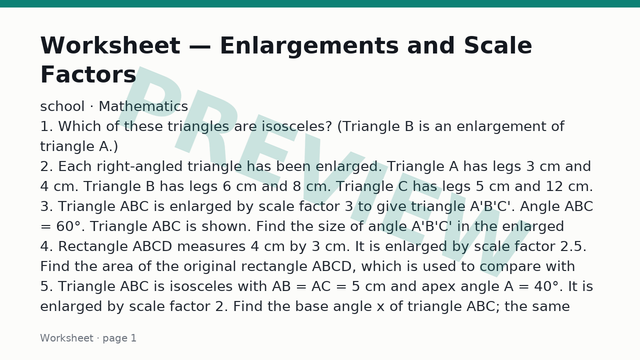
Enlargement affects the geometric properties of shapes in distinct ways. Every length on the original object is multiplied directly by the scale factor k to find the corresponding length on the image. If an edge length on the object is AB equals 5 cm, and the scale factor is 3, the corresponding image edge length A prime B prime equals 5 cm times 3, which equals 15 cm. If the scale factor is a fraction such as 0.5, the length becomes 5 cm times 0.5, which equals 2.5 cm.
In contrast, angles within the shape remain completely unchanged by enlargement. If an interior angle of a triangle ABC is angle ABC equals 60 degrees, the corresponding angle in the enlarged image, angle A prime B prime C prime, remains exactly 60 degrees. Enlarging a shape stretches the linear distances between vertices, but it does not alter the sharpness or openness of the corners. This preservation of interior angles is the defining feature of mathematical similarity, ensuring that the enlarged image has the exact same shape structure, proportions, and visual appearance as the original object, just scaled up or down in overall size.
Finding the Scale Factor and Centre of Enlargement
When an object and its enlarged image are both drawn on a plane, identifying the transformation parameters requires working backwards. To find the scale factor, select any corresponding pair of side lengths on the image and the object. Divide the length of the image side by the length of the corresponding object side. The resulting quotient is the scale factor k. For instance, if an image side is 12 cm and the corresponding object side is 4 cm, the scale factor is 12 divided by 4, which equals 3. If the image is smaller than the object, the image side divided by the object side will yield a proper fraction between 0 and 1, confirming a fractional scale factor.
To find the centre of enlargement, use the ray construction method in reverse. Identify corresponding pairs of vertices, such as vertex A and its image vertex A prime, vertex B and its image vertex B prime, and vertex C and its image vertex C prime. Use a straightedge to draw a continuous straight construction line passing through A and A prime. Draw a second straight construction line passing through B and B prime. Continue these lines until they intersect. The single point where these construction lines cross is the exact centre of enlargement. Drawing a third line through C and C prime serves as a check, because all three lines must intersect at this exact same single point.
Common Misconceptions and Errors
Learners frequently encounter specific pitfalls when working with enlargements and scale factors. One common error involves adding the scale factor to the side lengths instead of multiplying them. For example, if an object side is 4 cm and the scale factor is 3, a learner might incorrectly calculate the new side as 4 plus 3, giving 7 cm, rather than multiplying 4 times 3 to get 12 cm. Enlargement is a multiplicative process, not an additive one.
Another frequent mistake occurs when students attempt to find the centre of enlargement by using only one pair of corresponding vertices. Connecting A to A prime creates a line, but a single line contains an infinite number of possible points for the centre. At least two pairs of corresponding vertices, and preferably three, must be connected with projection rays to find their unique intersection point.
A third misconception relates to the effect of enlargement on angles. Students often assume that because the shape is getting larger, the interior angles must also increase in size. It is vital to remember that angle measurement is a measure of turning, not length, and interior angles remain strictly unchanged during any enlargement.