
الشرح
Introduction to Polygons and Quadrilaterals
A polygon is a two-dimensional closed geometric figure made of a finite number of straight line segments connected end-to-end. The segments are called the sides of the polygon, and the points where two sides meet are called the vertices. A polygon is convex if all its interior angles are strictly less than 180 degrees and no portion of any line segment connecting two interior points lies outside the figure. The simplest polygon with more than three sides is the quadrilateral, which has four sides and four vertices. Common examples of quadrilaterals include squares, rectangles, parallelograms, rhombuses, trapeziums, and general irregular four-sided shapes. Polygons are named according to their number of sides, n. A triangle has three sides, a quadrilateral has four, a pentagon has five, a hexagon has six, a heptagon has seven, an octagon has eight, a nonagon has nine, and a decagon has ten sides. Every polygon has interior angles, which are formed inside the shape between two adjacent sides, and exterior angles, which are formed outside the shape by extending one side past a vertex.
Understanding the geometry of polygons requires examining the relationship between the number of sides and the angles contained within the perimeter. A regular polygon has all sides of equal length and all interior angles of equal measure. An irregular polygon has sides of varying lengths or interior angles of varying measures, or both. The study of these shapes forms the foundation of spatial reasoning and geometric measurement in lower-secondary mathematics, aligning with CBSE Class 8-9 and Cambridge Lower Secondary Stage 8-9 curricula. Mastery of polygon angles enables learners to break complex shapes into simpler triangles, a fundamental problem-solving strategy in geometry.
Interior Angle Sum of Polygons
The sum of the interior angles of any polygon depends directly on its number of sides, denoted by the letter n. To find this sum, a single vertex inside the polygon can be chosen, and straight diagonal lines can be drawn from that vertex to all other non-adjacent vertices. For a quadrilateral, choosing vertex A and drawing a diagonal to vertex C divides the four-sided shape into two non-overlapping triangles. Since the sum of the angles in any triangle is 180 degrees, the interior angle sum of a quadrilateral is two times 180 degrees, which equals 360 degrees. For a pentagon, choosing one vertex allows two diagonals to be drawn, dividing the five-sided shape into three triangles. The interior angle sum of a pentagon is three times 180 degrees, which equals 540 degrees.
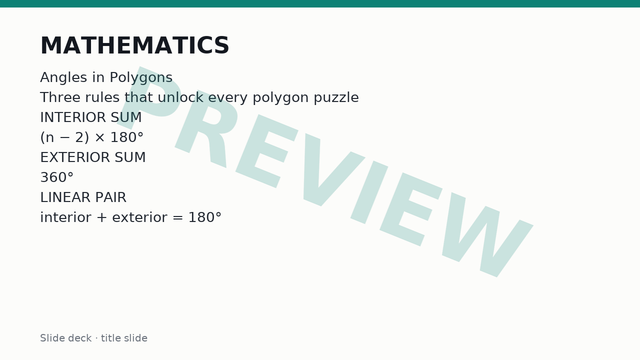
Extending this pattern to any n-sided polygon, drawing diagonals from a single vertex divides the polygon into (n - 2) triangles. Because each triangle contributes 180 degrees to the total angle sum, the formula for the sum of the interior angles of an n-sided polygon is given by the expression (n - 2) times 180 degrees. For example, a decagon has ten sides, so substituting n = 10 into the formula yields (10 - 2) times 180 degrees, which is 8 times 180 degrees, resulting in 1440 degrees. This formula applies universally to all convex polygons, regardless of whether they are regular or irregular. For a regular polygon with n sides, all n interior angles are equal in measure. Therefore, the measure of a single interior angle of a regular polygon can be found by dividing the total interior angle sum by the number of sides, yielding the formula ((n - 2) times 180 degrees) divided by n.
Exterior Angles of Polygons
An exterior angle of a polygon is formed when one side of the polygon is extended outwards past a vertex. At each vertex of a convex polygon, there is an interior angle and an exterior angle. These two angles lie on a straight line, which means an interior angle and its adjacent exterior angle always add up to 180 degrees and form a linear pair. If a polygon has n vertices, there are n exterior angles when one side is extended at each vertex in a consistent clockwise or anticlockwise direction around the perimeter.
One of the most powerful rules in polygon geometry is that the sum of the exterior angles of any convex polygon, taken one at each vertex, is always equal to 360 degrees. This fact remains true regardless of the number of sides the polygon has. Imagine walking around the perimeter of a polygon and making a complete turn at each vertex. By the time you return to your starting point and face your original direction, you have completed one full rotation of 360 degrees. This demonstrates why the exterior angle sum is independent of n. For a regular polygon with n sides, all n exterior angles are equal in measure. Consequently, the measure of a single exterior angle of a regular polygon is found by dividing 360 degrees by n, giving the formula 360 degrees divided by n. Alternatively, once the exterior angle of a regular polygon is known, the interior angle can be calculated by subtracting the exterior angle from 180 degrees.
Common Misconceptions and Troubleshooting
Learners frequently encounter specific pitfalls when working with interior and exterior angles of polygons. One common error is believing that the sum of the interior angles of a polygon changes depending on whether the shape is regular or irregular. Learners must understand that the formula (n - 2) times 180 degrees depends solely on the number of sides n, and applies equally to regular and irregular convex polygons. Another widespread misconception is that exterior angles of a polygon add up to 180 degrees instead of 360 degrees, often confusing exterior angle sums with the angle sum of a single triangle or a linear pair. It is vital to remember that a full trip around any closed convex polygon involves turning a total of 360 degrees.
A third frequent mistake occurs when extending sides to find exterior angles. Learners sometimes extend both sides that meet at a vertex, creating vertically opposite angles instead of a single exterior angle that forms a linear pair with the interior angle. To avoid this, learners should extend only one side of the vertex in the direction of travel around the perimeter. Finally, when calculating angles in algebraic polygon problems, arithmetic errors in expanding brackets or dividing large sums can be prevented by writing down every intermediate step and checking that interior and exterior angles at any vertex sum to 180 degrees.
Worked Examples
This section provides three fully worked examples demonstrating the application of interior and exterior angle rules in quadrilaterals and polygons.
Example 1: Finding an unknown angle in an irregular quadrilateral. Consider quadrilateral ABCD where angle ABC = 70 degrees, angle BCD = 110 degrees, and angle CDA = 80 degrees. Calculate the size of angle DAB, labelled as x degrees.
Solution:
Step 1: State the interior angle sum for a quadrilateral. A quadrilateral has 4 sides, so n = 4. Using the formula (n - 2) times 180 degrees, the sum is (4 - 2) times 180 degrees = 2 times 180 degrees = 360 degrees.
Step 2: Set up an equation adding all four interior angles to the total sum. angle DAB + angle ABC + angle BCD + angle CDA = 360 degrees, which becomes x + 70 + 110 + 80 = 360.
Step 3: Simplify the known angle values. 70 + 110 + 80 = 260, so x + 260 = 360.
Step 4: Solve for x by subtracting 260 from 360. x = 360 - 260 = 100.
Conclusion: angle DAB = 100 degrees.
Example 2: Finding the number of sides of a regular polygon given its interior angle. A regular polygon has an interior angle of 135 degrees. Determine the number of sides, n, of this polygon.
Solution:
Step 1: Use the relationship between interior and exterior angles. An interior angle and its adjacent exterior angle form a straight line and add up to 180 degrees.
Step 2: Calculate the size of one exterior angle. Exterior angle = 180 degrees - 135 degrees = 45 degrees.
Step 3: Use the exterior angle sum rule for regular polygons. The sum of all exterior angles is 360 degrees, and each exterior angle is equal. Therefore, n times exterior angle = 360 degrees, which means n times 45 = 360.
Step 4: Solve for n by dividing 360 by 45. n = 360 / 45 = 8.
Conclusion: The regular polygon has 8 sides, making it a regular octagon.
Example 3: Calculating interior and exterior angles of a regular pentagon. For a regular pentagon, calculate the size of one exterior angle and one interior angle.
Solution:
Step 1: Identify the number of sides for a pentagon, which is n = 5.
Step 2: Calculate the size of one exterior angle using the formula 360 degrees divided by n. Exterior angle = 360 / 5 = 72 degrees.
Step 3: Calculate the size of one interior angle using the linear pair rule where interior angle + exterior angle = 180 degrees. Interior angle = 180 degrees - 72 degrees = 108 degrees.
Step 4: Verify the interior angle using the interior angle formula ((n - 2) times 180) / n. ((5 - 2) times 180) / 5 = (3 times 180) / 5 = 540 / 5 = 108 degrees.
Conclusion: Each exterior angle is 72 degrees and each interior angle is 108 degrees.