La explicación
Introduction to Congruence
In geometry, two figures are said to be congruent if they have the exact same shape and the exact same size. When two geometric objects are congruent, one can be placed on top of the other so that they match up completely. Every side length and every interior angle of the first figure is equal in measure to the corresponding side length and interior angle of the second figure. For triangles specifically, having three pairs of matching sides and three pairs of matching angles means the triangles are congruent.
Consider two triangles named triangle ABC and triangle PQR. If triangle ABC is congruent to triangle PQR, this is written in mathematical notation as triangle ABC is congruent to triangle PQR. The order of the letters in triangle names is critically important because it defines the corresponding vertices. The first letter A corresponds to vertex P, vertex B corresponds to vertex Q, and vertex C corresponds to vertex R. This means side AB is equal in length to side PQ, side BC is equal in length to side QR, and side AC is equal in length to side PR. Furthermore, angle ABC is equal in measure to angle PQR, angle BCA is equal in measure to angle QRP, and angle CAB is equal in measure to angle RPQ.
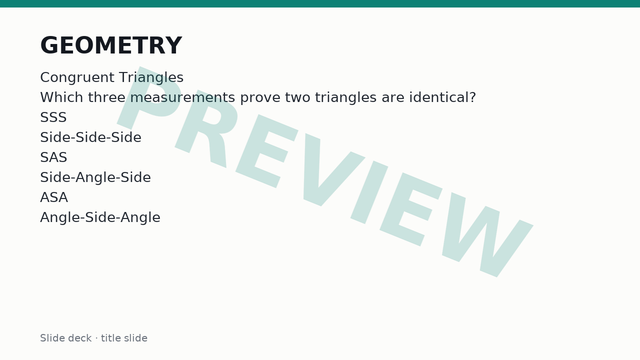
Checking all six pairs of measurements, meaning three sides and three angles, is unnecessary to prove that two triangles are congruent. Mathematicians have established minimum conditions that guarantee congruence. If certain combinations of three specific measurements in one triangle are equal to the corresponding measurements in another triangle, the remaining measurements are automatically forced to be equal. These minimum conditions are known as the standard congruence criteria: Side-Side-Side (SSS), Side-Angle-Side (SAS), Angle-Side-Angle (ASA), and Right-angle-Hypotenuse-Side (RHS).
The SSS and SAS Criteria
The first congruence condition is Side-Side-Side, abbreviated as SSS. The SSS criterion states that if three sides of one triangle are respectively equal in length to the three sides of another triangle, then the two triangles are congruent. For example, if triangle ABC has side lengths AB = 5 cm, BC = 7 cm, and AC = 9 cm, and triangle DEF has side lengths DE = 5 cm, EF = 7 cm, and DF = 9 cm, then triangle ABC is congruent to triangle DEF by SSS. No other triangle can be constructed with these three fixed side lengths because the rigid links lock the shape completely.
The second congruence condition is Side-Angle-Side, abbreviated as SAS. The SAS criterion states that if two sides and the included angle of one triangle are equal to two sides and the included angle of another triangle, then the two triangles are congruent. The term included angle refers specifically to the interior angle formed between the two known sides. For instance, if side AB = 6 cm, side BC = 8 cm, and angle ABC = 55 degrees in triangle ABC, and side PQ = 6 cm, side QR = 8 cm, and angle PQR = 55 degrees in triangle PQR, the triangles are congruent by SAS. Notice that angle ABC is formed by the meeting of side AB and side BC, making it the included angle between those two specific sides. If the known angle were instead angle BCA, which lies opposite side AB, the SAS condition would not be met, and the triangles might not be congruent.
The ASA and RHS Criteria
The third congruence condition is Angle-Side-Angle, abbreviated as ASA. The ASA criterion states that if two angles and the included side of one triangle are equal to two angles and the included side of another triangle, then the two triangles are congruent. The included side is the physical side that lies directly between the two known vertices containing the two angles. For example, in triangle ABC, if angle CAB = 40 degrees, angle ABC = 60 degrees, and the side AB between them is 7 cm, any other triangle with angles of 40 degrees and 60 degrees and a side of 7 cm connecting those two angles will be an exact duplicate in shape and size. Note that the AAS condition, sometimes called SAA, is a direct consequence of ASA because the sum of interior angles in any triangle is 180 degrees. If two angles are known, the third angle is automatically fixed, so knowing two angles and a non-included side also guarantees congruence.
The fourth congruence condition applies exclusively to right-angled triangles and is called Right-angle-Hypotenuse-Side, abbreviated as RHS. The RHS criterion states that if the hypotenuse and one other side of a right-angled triangle are equal in length to the hypotenuse and one other side of another right-angled triangle, then the two triangles are congruent. The hypotenuse is always the longest side of a right-angled triangle, located directly opposite the 90-degree right angle. For example, if triangle ABC has a right angle at angle ABC = 90 degrees, a hypotenuse AC = 10 cm, and a side BC = 6 cm, and triangle XYZ has a right angle at angle XYZ = 90 degrees, a hypotenuse XZ = 10 cm, and a side YZ = 6 cm, then triangle ABC is congruent to triangle XYZ by RHS. Without a right angle, having two side lengths and a non-included angle, sometimes called SSA or ASS, does not guarantee congruence because two different triangles can often be formed.
Working with Proofs and Examples
Establishing congruence in geometric problem-solving requires a clear, structured layout. Every statement made in a proof must be supported by a valid geometrical reason. When working with shapes that share sides or angles, look for hidden shared properties such as common sides, vertically opposite angles, or alternate interior angles formed by parallel lines.
Consider the first worked example. Triangle ABC and triangle DCB share a common side BC. It is given that side AB = side DC and angle ABC = angle DCB = 90 degrees. To prove that triangle ABC is congruent to triangle DCB, inspect the given information and the shared components. Side AB equals side DC is given. Angle ABC equals angle DCB equals 90 degrees is given. Side BC equals side CB is a common side. Therefore, triangle ABC is congruent to triangle DCB by the RHS criterion because both triangles have a right angle, a common hypotenuse BC, and a pair of equal shorter sides AB and DC.
Consider the second worked example involving intersecting lines. Let line segment AD intersect line segment BC at point O, such that point O is the exact midpoint of both segments. This means AO = DO and BO = CO. To prove that triangle AOB is congruent to triangle DOC, state the equal parts: AO = DO because O is the midpoint of AD, BO = CO because O is the midpoint of BC, and angle AOB = angle DOC because they are vertically opposite angles. The side AO and side BO enclose angle AOB, and side DO and side CO enclose angle DOC. Therefore, triangle AOB is congruent to triangle DOC by the SAS criterion.
Consider the third worked example involving a line of symmetry in an isosceles triangle. Let triangle ABC be an isosceles triangle where side AB = side AC. Let line AD be drawn from vertex A to the midpoint D on side BC, so that BD = DC. To prove that triangle ABD is congruent to triangle ACD, list the equal components: side AB = side AC is given, side BD = side CD is given because D is the midpoint of BC, and side AD = side AD is a common side shared by both triangles. Therefore, triangle ABD is congruent to triangle ACD by the SSS criterion. From this congruence, it can also be deduced that angle ADB = angle ADC = 90 degrees and angle BAD = angle CAD, showing that line AD is an angle bisector and perpendicular bisector.
Common Misconceptions and Errors
Learners frequently encounter difficulties when identifying whether two triangles are congruent or when writing out the correct reasoning. One major error involves using the SSA or ASS condition, which is side-side-non-included-angle. Unlike SAS, where the angle is strictly sandwiched between the two known sides, having two sides and an angle that is not between them does not guarantee congruence. Two entirely different triangles can often be drawn with the same two side lengths and a non-included angle.
Another common mistake is mixing up the order of letters in congruence statements. Writing that triangle ABC is congruent to triangle QRP when vertex A corresponds to vertex P rather than vertex Q alters the matching of sides and angles, making the mathematical statement false. Every letter must be written in exact correspondence with its matching vertex in the other triangle.
A third error occurs when learners assume triangles are congruent simply because they look the same size in a poorly drawn diagram. Geometric diagrams in textbooks or tests are rarely drawn to exact scale unless specifically stated. Proofs must rely strictly on mathematically proven given facts, marked equality dashes, angle markers, parallel line arrows, and established geometric theorems rather than visual estimation.
Finally, learners sometimes try to apply the RHS criterion to triangles that do not contain a 90-degree right angle. RHS stands for Right-angle-Hypotenuse-Side and is exclusively valid for right-angled triangles. If a triangle has no right angle, RHS cannot be used under any circumstances, even if two sides and a long side are known.