स्पष्टीकरण
Introduction to Similarity
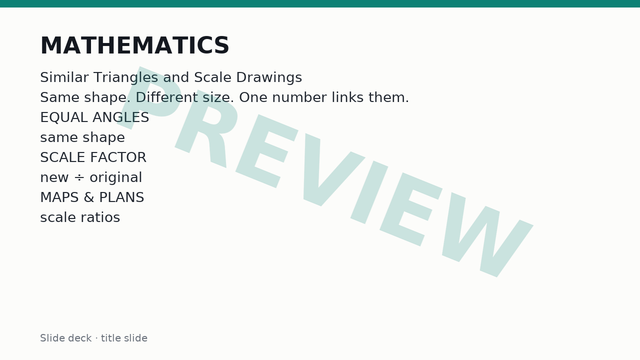
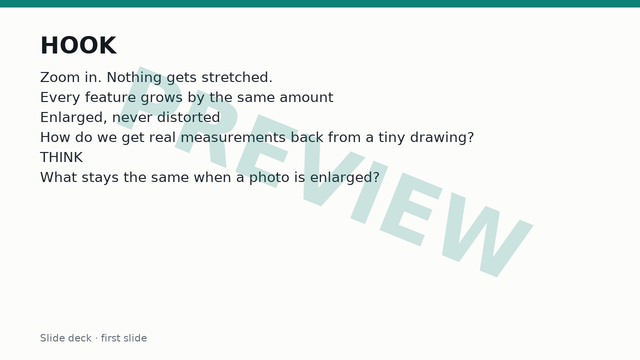
In geometry, shapes are described as similar when they share the exact same shape, though they do not necessarily share the same size. Unlike congruent shapes, which are identical in both shape and size, similar shapes can be larger or smaller versions of one another. Think of a photograph that has been enlarged or shrunk on a screen: every feature is stretched or compressed uniformly, meaning the image is not distorted. For any two geometric figures to be classified as similar, two fundamental conditions must be met simultaneously. First, all corresponding interior angles must be equal in measure. If angle ABC in the first triangle measures 50 degrees, the corresponding angle in the second triangle must also measure 50 degrees. Second, the lengths of all corresponding sides must be in the same proportion. This proportion is known as the scale factor. If one side of a shape is multiplied by a scale factor of 3 to produce the second shape, every other side of that first shape must also be multiplied by 3 to maintain similarity. If even one angle differs, or if the side lengths do not scale by a consistent multiplicative factor, the shapes are not similar. This concept applies to polygons of any number of sides, but it is most frequently studied using triangles because triangles are structurally rigid. Knowing that two triangles are similar allows mathematicians and engineers to calculate unknown distances, heights, and widths without needing to measure them directly in the physical world.
Identifying Similar Triangles
Triangles possess special properties that make testing for similarity efficient. Instead of checking every single angle and side length, geometric tests known as similarity criteria allow proof of similarity with fewer pieces of information. The primary criterion is Angle-Angle-Angle (AAA). If all three interior angles of one triangle are equal to the three corresponding interior angles of another triangle, the triangles are guaranteed to be similar. In fact, because the angles of any triangle always add up to 180 degrees, establishing that any two pairs of corresponding angles are equal is enough, as the third pair must also be equal. Another crucial criterion is Side-Side-Side (SSS) in proportion. If the ratios of all three pairs of corresponding sides are equal, the triangles are similar. For example, if triangle PQR has sides of length 3 cm, 4 cm, and 5 cm, and triangle XYZ has sides of length 6 cm, 8 cm, and 10 cm, the ratios of corresponding sides are 6 divided by 3, 8 divided by 4, and 10 divided by 5. Because every ratio simplifies to 2, the sides are in the same proportion, proving similarity. A third test is Side-Angle-Side (SAS) in proportion, where two pairs of corresponding sides are in the same ratio and the included angles between those sides are equal. When parallel lines intersect triangles, such as a line drawn parallel to one side of a triangle intersecting the other two sides, it creates a smaller triangle within a larger triangle that shares the same angles, thereby forming similar triangles.
Calculating Missing Lengths Using Scale Factors
Once similarity between two triangles is established, finding unknown side lengths becomes a matter of arithmetic using the scale factor. The scale factor is the multiplier that relates the lengths of the sides of the original figure to the lengths of the sides of the similar enlarged or reduced figure. To find the scale factor, locate a pair of corresponding sides where both lengths are known. Divide the length of the side on the new figure by the length of the corresponding side on the original figure. Scale factor equals new length divided by original length. If the new length is 12 cm and the original length is 4 cm, the scale factor is 3. To find an unknown side on the new figure, multiply the corresponding original side by the scale factor. Conversely, to work backwards from the new figure to the original figure, divide by the scale factor, or equivalently, multiply by the reciprocal scale factor. Setting up proportions is an alternative and equally powerful method. If side AB corresponds to side DE, and side BC corresponds to side EF, then the ratio of AB to DE is equal to the ratio of BC to EF. Cross-multiplication allows the solver to find any single missing value in the equation. Care must be taken to match corresponding sides correctly, ensuring that sides opposite equal angles are paired together in ratios.
Scale Drawings, Blueprints, and Maps
The principles of similarity govern all scale drawings, maps, blueprints, and architectural floor plans. A scale drawing is a representation of an actual object or place that is drawn larger or smaller than the actual size, maintaining exact similarity to reality. The scale is typically written as a ratio, such as 1 to 100, or using specific units, such as 1 cm represents 5 m. When a map uses a scale where 1 cm represents 10 km, it means every single centimetre measured on the paper corresponds to 10 kilometres in the physical world. To find the real distance between two towns on this map, measure the distance between them with a ruler in centimetres, then multiply that measurement by the scale value of 10 km. To create a scale drawing of a room, an architect uses a scale factor to reduce the real dimensions so they fit on a sheet of paper. If a room measures 400 cm by 300 cm, and the scale is 1 cm to 50 cm, divide both real dimensions by 50 to find the drawing dimensions: 400 divided by 50 gives 8 cm, and 300 divided by 50 gives 6 cm. The resulting rectangle on paper measuring 8 cm by 6 cm is mathematically similar to the real room, meaning all proportions, furniture placements, and pathway angles are accurately represented in miniature.
Common Misconceptions and Errors
Learners frequently encounter specific pitfalls when working with similar triangles and scale drawings. One common error is confusing congruence with similarity, assuming that shapes must be the exact same size to be similar. Another frequent mistake involves adding a fixed difference to side lengths rather than multiplying by a scale factor. For instance, if an original triangle has sides of 3 cm, 4 cm, and 5 cm, and a similar triangle has a shortest side of 6 cm, a learner might incorrectly add 3 cm to every side to get 6 cm, 7 cm, and 8 cm. The correct approach is to recognise that side lengths scale multiplicatively, so multiplying every side by a scale factor of 2 yields 6 cm, 8 cm, and 10 cm. A third error happens when learners misidentify corresponding sides in triangles that have been rotated or reflected. Rotating a triangle does not change its side lengths or angles, but it changes its visual orientation. Learners must always match sides based on their position relative to known equal angles rather than their physical orientation on the page, such as matching horizontal to vertical incorrectly. Finally, when dealing with area and scale factors, learners sometimes assume that if linear dimensions are multiplied by a scale factor of k, the area is also multiplied by k. In reality, area scales by the square of the scale factor, meaning if linear dimensions are doubled, the area increases by a factor of four.
Worked Examples
The following worked examples demonstrate how to apply similarity rules and scale factors to solve geometric problems step by step.