The explanation
Introduction to Parallel Lines and Transversals
Parallel lines are straight lines in a plane that are always the same distance apart and never meet, no matter how far they are extended. In diagrams, parallel lines are indicated by matching arrowheads placed on the lines. When a single straight line crosses two or more other lines, this intersecting line is called a transversal.
When a transversal crosses a pair of parallel lines, eight distinct angles are created at the two intersection points. These eight angles can be sorted into specific geometric relationships based on their relative positions. Understanding these relationships allows mathematicians to determine unknown angle measurements when only a single angle is known. Before exploring these pairs, it is essential to recall foundational angle rules such as vertically opposite angles being equal and angles on a straight line summing to 180 degrees. The intersection of the transversal with each parallel line creates four quadrants. The top line has angles labelled 1 to 4 and the bottom line has angles labelled 5 to 8, establishing positional matching between the upper and lower intersections.
Corresponding Angles
Corresponding angles occupy the same relative position at each intersection where a transversal crosses two parallel lines. If a learner slides an angle from the top intersection directly down the transversal onto the bottom intersection, the angle lands directly on top of its corresponding partner.
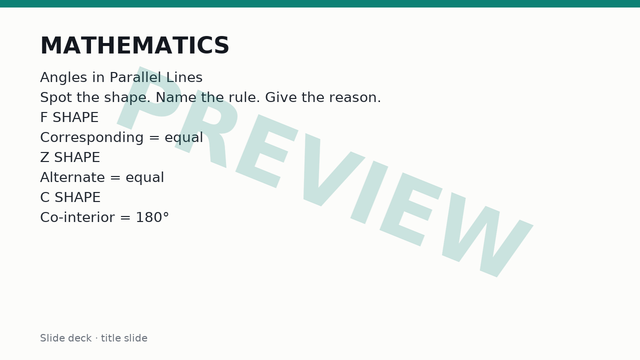
Corresponding angles are equal in size. In geometric proofs and problem solving, the standard geometric reason used is corresponding angles are equal. To identify corresponding angles visually, look for a distinct shape resembling the letter F. The F shape can be rotated, flipped horizontally, or inverted vertically, but the angles tucked inside the corners of the F and outside the parallel line on the corresponding side are always equal. For example, if the top-left angle at the upper intersection is 70 degrees, the top-left angle at the lower intersection is also 70 degrees because they are corresponding. Recognising this F-shape pattern is a fundamental skill for navigating complex multi-step geometric diagrams involving networks of intersecting straight lines.
Alternate Angles
Alternate angles lie on opposite sides of the transversal and in alternate positions relative to the two parallel lines. Specifically, alternate interior angles lie strictly between the two parallel lines, on opposite sides of the transversal.
Alternate angles are equal in size. The standard geometric reason used when calculating with alternate angles is alternate angles are equal. To identify alternate angles visually, look for a distinct shape resembling the letter Z or a lightning bolt. The Z shape can be standard, reversed, or rotated. The acute or obtuse angles nestled inside the sharp corners of the Z shape are alternate interior angles and are therefore equal. For example, if the bottom-right angle of the upper intersection is 110 degrees, the top-left angle of the lower intersection is also 110 degrees because they form an alternate pair. Mathematicians also recognise alternate exterior angles, which lie outside the parallel lines on opposite sides of the transversal, and these are likewise equal.
Co-interior Angles
Co-interior angles, sometimes referred to as consecutive interior angles, lie on the same side of the transversal and both lie between the two parallel lines. Unlike corresponding and alternate angles, co-interior angles are not equal to each other.
Co-interior angles always add up to 180 degrees, meaning they are supplementary. The standard geometric reason used in calculations is co-interior angles add to 180 degrees. To identify co-interior angles visually, look for a shape resembling the letter C or a squared-off U shape between the parallel lines. The two interior angles enclosed by the C shape have a sum of 180 degrees. For example, if one co-interior angle measures 120 degrees, the other co-interior angle must measure 60 degrees. This relationship arises because one angle is alternate to an angle on a straight line with the other, combining to form a linear pair.
Common Misconceptions
Learners frequently encounter difficulties when identifying angle relationships in parallel line diagrams. A prevalent error is assuming that all angle pairs formed by a transversal are equal, leading to the mistake of setting co-interior angles equal to each other instead of summing them to 180 degrees. The correction is to remember that only alternate and corresponding angles are equal, while co-interior angles are supplementary.
Another common error is relying on visual estimation rather than geometric properties, assuming lines are parallel when no arrowheads or formal statements confirm it. Parallel line rules only apply when the lines are explicitly stated to be parallel or marked with matching arrowheads.
A third error occurs when learners misidentify the letter shapes by failing to trace the transversal and parallel lines correctly, particularly when diagrams are rotated or embedded within complex polygons such as parallelograms and trapeziums. Always isolate the specific transversal and the two lines in question before naming the angle relationship.
Worked Examples
Worked examples demonstrate how to set out geometric calculations clearly, stating both the numerical steps and the exact geometric reasons required at lower-secondary level.
Example one involves finding an unknown angle using alternate angles. Consider two horizontal parallel lines, line AB and line CD, intersected by a transversal line EF at points G and H respectively. Angle AGH is given as 65 degrees, and angle GHD is labelled as x degrees. To find x, observe that angle AGH and angle GHD are alternate interior angles. Therefore, x = 65 because alternate angles are equal.
Example two involves finding an unknown angle using co-interior angles. Consider two parallel lines AB and CD intersected by transversal EF at points G and H. Angle BGH is given as 115 degrees, and angle GHC is labelled as y degrees. To find y, observe that angle BGH and angle GHC are co-interior angles. Therefore, y + 115 = 180 because co-interior angles add to 180 degrees. Subtracting 115 from 180 yields y = 65.
Example three involves a multi-step problem combining multiple angle rules. Consider parallel lines AB and CD intersected by transversal EF at G and H. Angle AGH is 70 degrees. Find angle CHG and angle DHH prime where H prime is a point extending the line. Angle AGH and angle CHG are corresponding angles, so angle CHG = 70 degrees because corresponding angles are equal. Then, angle DHC and angle CHG lie on a straight line EF, so angle DHC = 180 - 70 = 110 degrees because angles on a straight line add to 180 degrees.