
L'explication
Introduction and the Interior Angle Sum Property
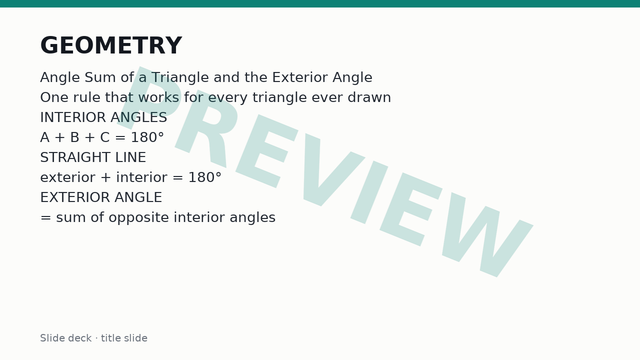
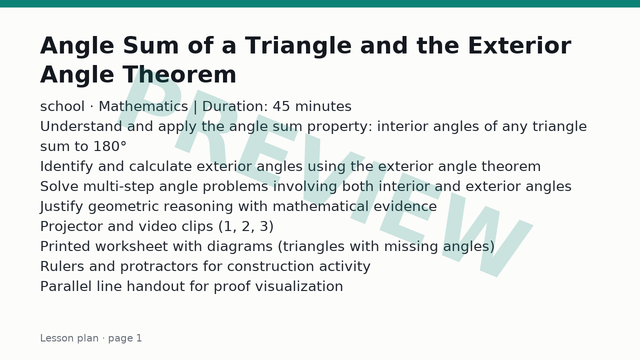
A triangle is a fundamental two-dimensional closed geometric shape formed by three straight line segments meeting at three vertices. The internal spaces created at these vertices are known as the interior angles of the triangle. One of the most foundational and powerful theorems in Euclidean geometry is the angle sum property of a triangle, which states that the sum of the three interior angles in any triangle is always exactly 180 degrees.
To understand why this is true, consider any triangle ABC, where vertex A has interior angle A, vertex B has interior angle B, and vertex C has interior angle C. If a line is constructed through vertex A that is parallel to the opposite base line BC, several important angle relationships emerge. Using the properties of parallel lines cut by transversals, specifically alternate interior angles, the angles formed along the straight line at vertex A can be shown to correspond directly to angle B and angle C. Because angles on a straight line always sum to 180 degrees, it follows that angle A plus angle B plus angle C must also equal 180 degrees. This property holds true regardless of whether the triangle is acute, right-angled, or obtuse, and regardless of the lengths of its sides.
Knowing that the interior angles always sum to 180 degrees allows for the calculation of an unknown third angle whenever two interior angles are known. For instance, if angle A is 50 degrees and angle B is 60 degrees, subtracting their sum from 180 degrees yields the remaining angle C, which must be 70 degrees. This principle is applied extensively across geometry to classify shapes, solve multi-step spatial problems, and verify architectural designs.
The Exterior Angle Theorem
When any side of a triangle is extended outwards past a vertex, a new angle is formed on the outside of the shape between the extended line and the adjacent side of the triangle. This is called an exterior angle of the triangle. Every triangle has six exterior angles in total, two at each vertex, which are vertically opposite and therefore equal in size. The exterior angle theorem establishes a direct relationship between an exterior angle and the interior angles of the triangle.
The theorem states that the measure of any exterior angle of a triangle is equal to the sum of the two interior opposite angles. To visualize this, consider triangle PQR where the side QR is extended past point R to a new point S, creating the exterior angle PRF at vertex R. The interior angle directly adjacent to this exterior angle is angle PRQ. The other two interior angles in the triangle, located at vertices P and Q, are called the interior opposite angles with respect to that exterior angle.
This relationship can be proven by combining two fundamental geometric facts. First, the adjacent interior angle and the exterior angle lie on a straight line, meaning they add up to 180 degrees. Second, all three interior angles of the triangle also add up to 180 degrees. Setting these two equations equal to each other demonstrates that the exterior angle must equal the sum of the two interior opposite angles. This theorem provides a direct shortcut for finding unknown angles without always needing to calculate the adjacent interior angle first.
Step-by-Step Worked Examples
Applying geometric theorems requires setting up clear equations and stating precise mathematical reasons for every calculation step. The following worked examples demonstrate how to find unknown angles using both the interior angle sum property and the exterior angle theorem.
Example 1: Finding an unknown interior angle
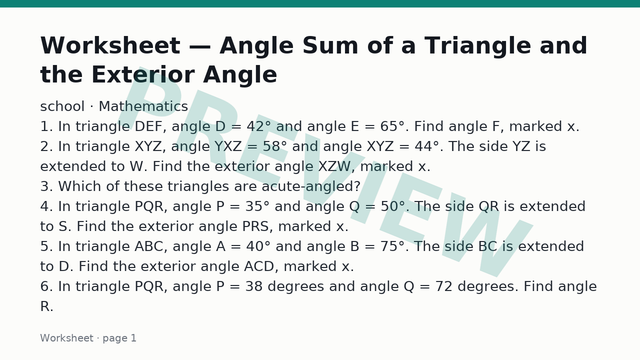
Consider triangle DEF. Angle D is given as 42 degrees, and angle E is given as 65 degrees. Calculate the size of angle F.
Solution:
- State the theorem: The sum of the interior angles of a triangle is 180 degrees.
- Set up the equation: angle D + angle E + angle F = 180 degrees.
- Substitute the known values: 42 degrees + 65 degrees + angle F = 180 degrees.
- Simplify the known sum: 107 degrees + angle F = 180 degrees.
- Solve for angle F by subtraction: angle F = 180 degrees - 107 degrees.
- State the final answer with units: angle F = 73 degrees.
Example 2: Finding an unknown exterior angle
Consider triangle XYZ. Side YZ is extended to a point W, forming the exterior angle XZW. The interior angle YXZ is 58 degrees, and the interior angle XYZ is 44 degrees. Calculate the size of exterior angle XZW.
Solution:
- State the theorem: An exterior angle of a triangle equals the sum of the two interior opposite angles.
- Identify the interior opposite angles for exterior angle XZW: these are angle YXZ and angle XYZ.
- Set up the equation: angle XZW = angle YXZ + angle XYZ.
- Substitute the known values: angle XZW = 58 degrees + 44 degrees.
- Calculate the sum: angle XZW = 102 degrees.
- State the final answer with units: angle XZW = 102 degrees.
Example 3: Multi-step angle chasing with algebraic expressions
Consider triangle ABC. Interior angle A is given as x degrees, interior angle B is given as (2x + 10) degrees, and interior angle C is given as (3x - 20) degrees. Find the numerical value of x and the size of each angle.
Solution:
- State the theorem: The sum of the interior angles of a triangle is 180 degrees.
- Set up the algebraic equation: x + (2x + 10) + (3x - 20) = 180.
- Collect like terms: 6x - 10 = 180.
- Add 10 to both sides: 6x = 190.
- Divide by 6: x = 31.67 degrees (or leave as a fraction 95/3).
- Substitute x back into each expression to find the individual angles: angle A = 31.67 degrees, angle B = 2(31.67) + 10 = 73.34 degrees, and angle C = 3(31.67) - 20 = 75.01 degrees.
Common Misconceptions and Troubleshooting
Learners frequently encounter specific pitfalls when working with triangle angles. Recognizing these misconceptions helps prevent calculation errors and strengthens geometric reasoning.
One common error is confusing the exterior angle with the adjacent interior angle, or attempting to add all three interior angles to the adjacent interior angle to equal 180 degrees. It is vital to remember that the exterior angle and its adjacent interior angle form a linear pair adding to 180 degrees, whereas the exterior angle equals the sum of the two distant interior opposite angles.
Another frequent mistake occurs when learners assume all triangles are equilateral or isosceles unless marked otherwise. Students often mistakenly divide 180 degrees by three automatically, or assume that any two angles in a random triangle are equal. Every triangle must be treated according to its specific given values or markings.
Finally, when dealing with algebraic angle problems, learners sometimes forget to include brackets or make sign errors when collecting like terms. Writing out every intermediate step of the algebraic expansion prevents these clerical mistakes and ensures accurate solutions.