
వివరణ
The Cartesian Plane and Coordinates
The Cartesian plane is a two-dimensional surface defined by a horizontal number line called the x-axis and a vertical number line called the y-axis. These two axes intersect perpendicularly at a specific point called the origin, whose coordinates are written as (0, 0). The axes divide the plane into four regions called quadrants, which are numbered anticlockwise starting from the top-right as quadrant one, where both coordinates are positive. Every point on the Cartesian plane is identified by an ordered pair of numbers, written in the form (x, y). The first number is the x-coordinate, representing the horizontal distance and direction from the origin, where moving right is positive and moving left is negative. The second number is the y-coordinate, representing the vertical distance and direction from the origin, where moving up is positive and moving down is negative. Geometric shapes on the coordinate plane are formed by connecting multiple vertices, which are individual points defined by their coordinate pairs. Understanding these foundations allows the precise location, movement, and transformation of any geometric figure to be tracked through mathematical operations such as reflections.
Reflecting Across the Coordinate Axes
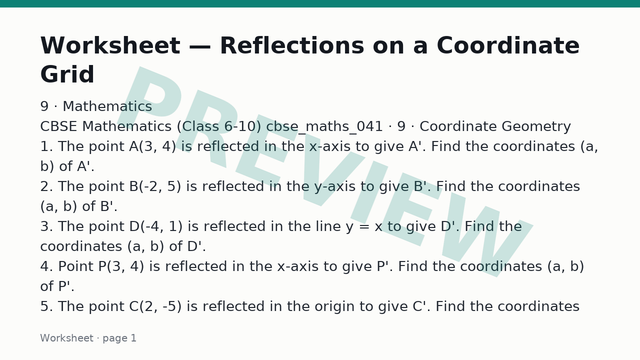
A reflection is a transformation that flips a geometric figure across a fixed line known as the mirror line or line of reflection. Every point of the original figure, known as the object, has a corresponding point on the reflected figure, known as the image. Under a reflection, the distance from any point on the object to the mirror line is exactly equal to the distance from its corresponding image point to the mirror line on the opposite side. Furthermore, the line segment joining any object point to its image point is perpendicular to the mirror line. When reflecting a point across the x-axis, the x-coordinate remains completely unchanged while the y-coordinate is multiplied by negative one, changing its sign from positive to negative or from negative to positive. For any point with coordinates (x, y), its reflection across the x-axis has the image coordinates (x, -y). For example, the point A with coordinates (3, 4) reflects across the x-axis to the image point A prime with coordinates (3, -4). Similarly, when reflecting a point across the y-axis, the y-coordinate remains completely unchanged while the x-coordinate is multiplied by negative one, changing its sign. For any point with coordinates (x, y), its reflection across the y-axis has the image coordinates (-x, y). For example, the point B with coordinates (-2, 5) reflects across the y-axis to the image point B prime with coordinates (2, 5). When reflecting an entire polygon such as a triangle, each vertex is transformed individually using these coordinate rules, and the vertices of the image are connected in the same sequence to maintain the shape and size, although the orientation is reversed, turning left-handedness into right-handedness.
Reflecting Across the Line y = x and Other Lines
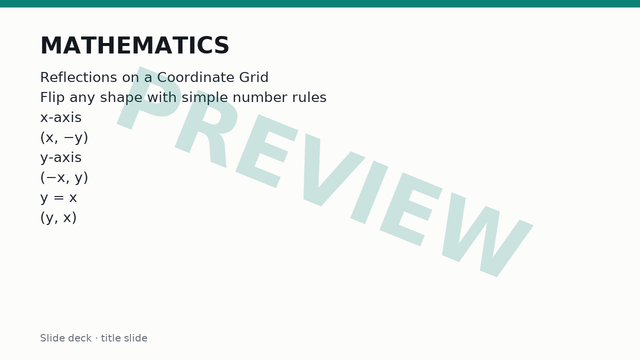
Beyond the principal coordinate axes, geometric shapes can be reflected across diagonal lines on the Cartesian plane. The most common diagonal mirror line is the line given by the equation y = x, which passes through the origin at a forty-five degree angle to both axes, cutting through the first and third quadrants. When a point with coordinates (x, y) is reflected across the line y = x, the x-coordinate and the y-coordinate swap places entirely. Therefore, for any point with coordinates (x, y), its reflection across the line y = x has the image coordinates (y, x). For example, the point C with coordinates (2, 5) reflects across the line y = x to the image point C prime with coordinates (5, 2). If the point has negative coordinates, such as point D with coordinates (-4, 1), its reflection across the line y = x produces the image point D prime with coordinates (1, -4). Another important diagonal line is the line given by the equation y = negative x, which passes through the second and fourth quadrants. When reflecting a point across the line y = negative x, the coordinates are both swapped and negated, transforming the point (x, y) into the image point (-y, -x). Reflections can also occur across any vertical line parallel to the y-axis, such as the line x = k, or any horizontal line parallel to the x-axis, such as the line y = k. When reflecting across a vertical line x = k, the y-coordinate of the point remains unchanged, while the x-coordinate is shifted so that the horizontal distance from the mirror line to the object point equals the horizontal distance from the mirror line to the image point. Specifically, if a point is a distance d to the right of the line x = k, its image is a distance d to the left of the line x = k, giving an image x-coordinate of k plus the quantity (k minus x), which simplifies to 2k minus x. Similarly, when reflecting across a horizontal line y = k, the x-coordinate remains unchanged, and the new y-coordinate becomes 2k minus y. To perform these reflections accurately, sketching the mirror line clearly on the coordinate grid and measuring perpendicular distances with grid units ensures that every vertex is positioned correctly before writing down the coordinates of the final image.
Describing Reflections Fully and Solving Problems
To fully describe a transformation as a reflection, specifying the correct type of transformation is only the first step; the exact position of the mirror line must also be given. Unlike translations, which require a vector, or rotations, which require a centre and an angle, a reflection is completely and uniquely defined by stating the equation of the mirror line. When given an object polygon and its corresponding image polygon on a coordinate grid, finding the mirror line requires geometric reasoning and systematic measurement. First, select a vertex on the object polygon and locate its corresponding image vertex on the reflected polygon. Draw a straight line segment connecting the object vertex to its image vertex. Next, find the exact midpoint of this line segment by counting the horizontal and vertical units between the two points and dividing those distances by two. The mirror line must pass directly through this midpoint. Finally, determine the orientation of the mirror line by finding a line that is perpendicular to the connecting segment and equidistant from all corresponding pairs of vertices. If the midpoint lies on the y-axis and the connecting segment is horizontal, the mirror line is the y-axis itself, written as the equation x = 0. If the corresponding vertices have identical y-coordinates but opposite x-coordinates shifted symmetrically, the mirror line is the y-axis. If the coordinates of the object and image have their x and y values swapped, the mirror line is the diagonal line y = x. Once the equation of the mirror line is identified, the full description is written concisely, stating that the transformation is a reflection in the line with that specific equation. Solving complex coordinate geometry problems often involves combining reflections with other geometric properties, such as calculating the area of the reflected shape, finding the length of sides using the distance formula, or determining the coordinates of a polygon after successive reflections across multiple different mirror lines. Because reflections are isometric transformations, they preserve the exact lengths of all sides, the sizes of all interior angles, and the perimeter and area of the original shape, changing only its orientation on the plane.