The explanation
The Cartesian Plane and Coordinates
The Cartesian plane is a two-dimensional surface defined by a horizontal number line, known as the x-axis, and a vertical number line, known as the y-axis. These two axes intersect perpendicularly at a specific point called the origin, which has the coordinates (0, 0). The plane is divided into four regions called quadrants, numbered in an anti-clockwise direction starting from the top right where both coordinates are positive.
Every point on the Cartesian plane is identified by an ordered pair of numbers written in parentheses, such as (x, y). The first number, the x-coordinate, indicates the horizontal distance and direction from the origin along the x-axis. A positive x-coordinate means a movement to the right, while a negative x-coordinate means a movement to the left. The second number, the y-coordinate, indicates the vertical distance and direction from the origin along the y-axis. A positive y-coordinate means a movement upwards, while a negative y-coordinate means a movement downwards.
For example, the point A with coordinates (3, 4) is located by starting at the origin, moving 3 units to the right along the x-axis, and then moving 4 units upwards parallel to the y-axis. Conversely, the point B with coordinates (-2, -5) is located by starting at the origin, moving 2 units to the left along the x-axis, and then moving 5 units downwards parallel to the y-axis. Mastery of the Cartesian plane is essential because all geometric transformations, including translations, rely on tracking how the coordinates of points change when an object is moved across the grid.
Introduction to Column Vectors
In mathematics, a vector is a quantity that has both magnitude, representing length or distance, and direction. While standard numbers describe size alone, vectors describe a displacement from one point to another in space. On a coordinate grid, a translation is fully described by a column vector, which is a convenient way to write this displacement without relying on directional words.
A column vector consists of two numbers enclosed in a vertical pair of brackets, written with one number directly above the other. The top number represents the horizontal displacement, and the bottom number represents the vertical displacement. For instance, the column vector [a, b] in bracket notation means a movement of a units horizontally and b units vertically. If the top number is positive, the movement is to the right; if negative, the movement is to the left. If the bottom number is positive, the movement is upwards; if negative, the movement is downwards.
Consider the column vector [4, -3]. This vector instructs any point or shape to move 4 units to the right and 3 units downwards. It is important to distinguish between a point and a vector. A point refers to a fixed position on the Cartesian plane, such as the point (2, 5). A vector refers to a movement or shift, meaning it has no fixed starting position. The same column vector [4, -3] can be applied to the origin, to the vertex of a triangle, or to any random point on the plane, and the resulting shift in position will be identical in terms of distance and direction.
Translating Points and Shapes Using Column Vectors
A translation is a type of geometric transformation that moves every point of a shape by the same distance in the same direction. During a translation, the shape does not rotate, reflect, or change its size or shape; it merely slides across the Cartesian plane. The original shape is referred to as the object, and the resulting shape after the translation is referred to as the image.
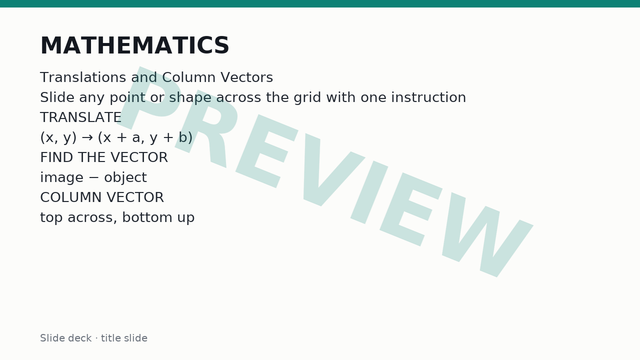
To translate a point with coordinates (x, y) by a column vector [a, b], the new coordinates of the image are found by simply adding the components of the vector to the coordinates of the object. The x-coordinate of the image becomes x + a, and the y-coordinate of the image becomes y + b. In coordinate notation, this can be expressed as (x, y) maps to (x + a, y + b).
When translating a composite geometric shape, such as a triangle or a polygon, every vertex of the shape must be translated individually using the same column vector. For example, if a triangle has vertices at points P, Q, and R, each vertex coordinate is subjected to the same vector addition. Once all the new image vertices, designated as P-prime, Q-prime, and R-prime, are calculated and plotted on the grid, they are connected with straight line segments to complete the image of the translated shape. Line segments connecting original object vertices to their corresponding image vertices are always parallel and equal in length.
Finding the Column Vector from Object and Image
Sometimes the initial object and its translated image are both shown on the Cartesian plane, and the task is to determine the column vector that describes the translation. This requires working backward by comparing the coordinates of a vertex on the object with the coordinates of its corresponding vertex on the image.
To find the horizontal component of the column vector, subtract the x-coordinate of the object vertex from the x-coordinate of the image vertex. To find the vertical component, subtract the y-coordinate of the object vertex from the y-coordinate of the image vertex. This can be summarized by the formula: vector equals image coordinates minus object coordinates. For example, if an object vertex is at point (1, 2) and its corresponding image vertex is at point (5, 5), the horizontal movement is 5 minus 1, which equals 4, and the vertical movement is 5 minus 2, which equals 3. Therefore, the column vector describing this translation is [4, 3].
It is good mathematical practice to verify this calculation by checking another vertex on the shape. Because a translation shifts every part of the shape uniformly, the difference between the coordinates of any object vertex and its corresponding image vertex must yield the exact same column vector. If different vertices produce different vectors, either a plotting error has occurred or the transformation is not a pure translation.
Common Misconceptions and Troubleshooting
Learners often encounter specific pitfalls when studying translations and column vectors, and being aware of these helps prevent recurring errors. One common mistake is confusing the order of numbers inside a column vector, treating the vertical movement as the top number and the horizontal movement as the bottom number. The universal convention dictates that the top number is always the horizontal movement along the x-axis, and the bottom number is always the vertical movement along the y-axis.
Another frequent error involves getting signs mixed up when moving in negative directions on the grid. Learners may assume that a vector with a negative number indicates subtraction of a positive distance rather than a directed movement. For instance, applying the vector [2, -4] means adding 2 to the x-coordinate and adding negative 4, which is equivalent to subtracting 4, from the y-coordinate. It is vital to perform algebraic addition of signed numbers rather than treating negative numbers as simple subtraction symbols.
A third misconception is translating only one vertex of a polygon and leaving the rest of the shape behind or attempting to resize the shape during the translation. A translation is a rigid transformation, meaning every single vertex of the object must undergo the exact same vector displacement. Checking that all corresponding side lengths remain equal and that lines joining object vertices to image vertices are parallel helps ensure the translation has been carried out accurately.